
A sustainable and efficient housing solution for the Artist Village site in Belapur, Navi Mumbai — addressing urban challenges through a cluster-based planning approach with a mix of 1BHK, 2BHK, and 3BHK units, shared community spaces, and net-positive energy design guided by a multidisciplinary team of 30+ students from IIT Bombay.
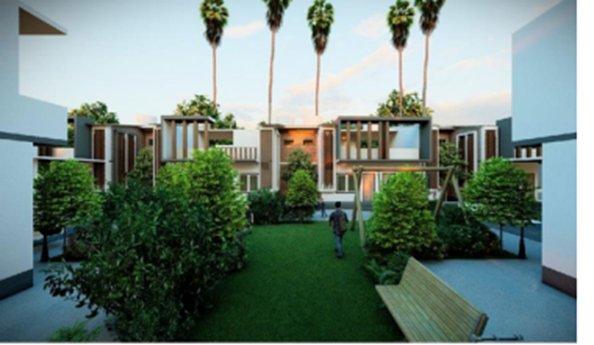
Project Daksh was Team SHUNYA's entry to the US Solar Decathlon Design Challenge 2021. The project focused on developing a sustainable and efficient housing solution for the Artist Village site in Belapur, Navi Mumbai, tackling real urban challenges including inadequate emergency access, waterlogging, lack of parking, and poor natural lighting and ventilation.
A cluster-based planning approach was adopted — offering a mix of 1BHK, 2BHK, and 3BHK units alongside shared community spaces and improved infrastructure. The design leverages recycled materials, rainwater harvesting, greywater recycling, GFRG panels, and a smart automation system for HVAC, lighting, and appliances, all integrated through a user-friendly interface.
The result is a scalable, cost-effective, and environmentally responsive residential system that preserves the existing community character while achieving net-positive energy performance. The project earned 2nd position in the Attached Housing Division at the US Solar Decathlon Design Challenge and received the Best Graphic Designer Award for its presentation and visualization. The team was guided by faculty mentors led by Prof. Rangan Banerjee and supported by industry partners and IIT Bombay STP.
Modular layout with 1BHK, 2BHK, and 3BHK units adaptable to similar urban environments, enabling efficient land use and a replicable model for sustainable neighbourhood-scale housing.
Recycled materials, rainwater harvesting, greywater recycling, and GFRG panels deliver energy-efficient construction with low lifecycle resource consumption and long-term resilience.
A unified smart control system manages HVAC, lighting, and appliances across the development through a user-friendly interface, optimising energy use without sacrificing comfort.
Construction cost is significantly lower than conventional benchmarks, ensuring economic viability while maintaining the social and spatial character envisioned in the original planning framework.
An optimised photovoltaic system generates clean electricity, sized and oriented for net-positive output across the entire cluster development.
A unified smart system manages HVAC, lighting, and appliances across all units, optimising consumption in real time through an intuitive user interface.
All units across the Artist Village cluster are powered efficiently, with surplus energy exported to the grid — achieving net-positive performance at development scale.
A modular cluster layout addresses real site challenges at the Artist Village, Belapur — including inadequate emergency access, waterlogging, poor parking, and insufficient natural lighting and ventilation.
A balanced mix of 1BHK, 2BHK, and 3BHK units alongside shared community spaces creates a scalable residential system that preserves the social character of the existing community.
Glass Fibre Reinforced Gypsum panels combined with recycled construction materials deliver a high-performance building envelope at a construction cost significantly below conventional benchmarks.
Integrated water management systems capture and reuse rainwater and greywater across the cluster, drastically reducing freshwater demand and supporting long-term resource resilience.
A unified control interface manages HVAC, lighting, and appliances across all units, enabling optimised energy use, occupant comfort, and real-time monitoring throughout the development.
Through optimised resource utilisation and solar integration, the entire cluster achieves net-positive energy performance — demonstrating a replicable, economically viable model for sustainable urban housing.
Discover SHUNYA's full portfolio of solar innovations spanning a decade.