
An 800 sq.ft. prefabricated, single-storey modular house engineered for sustainability, energy efficiency, and innovative building systems — representing India at one of Europe's most prestigious solar design competitions, with two patents and multiple research publications to its name.
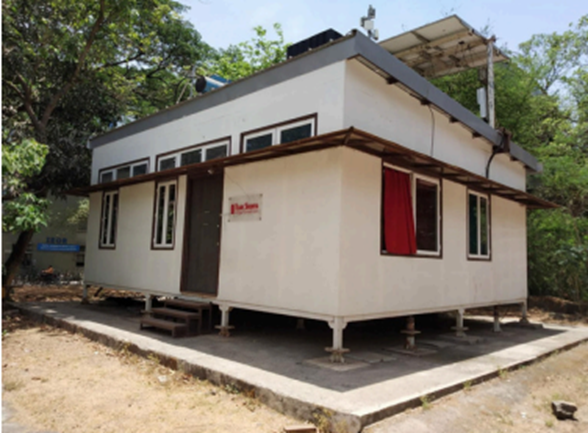
Project H-Naught was Team SHUNYA's entry to the Solar Decathlon Europe 2014, held at the Palace of Versailles, France — one of the world's most prestigious solar building competitions. The project developed an 800 sq.ft. single-storey modular house with a focus on sustainability, energy efficiency, and innovative building systems, earning an Honourable Mention for Sustainability from the competition jury.
A standout achievement was the development of a clothes dryer utilising waste heat from HVAC and solar thermal systems, a technology novel enough to be filed for patent. The project also featured a patented solar oven capable of reaching temperatures up to 220°C, demonstrating the team's depth of innovation across the building's energy systems.
Complementing the hardware innovations, the team published research on building simulation-based optimisation using design of experiments, and integrated Phase Change Materials for thermal storage to further enhance solar thermal efficiency. In total, the project produced two patents and multiple research publications, and achieved the highest points in engineering innovation in the competition.
A clothes dryer harnessing waste heat from HVAC and solar thermal systems — a novel approach filed for patent, turning thermal by-products into a usable energy resource.
Patented solar oven technology capable of achieving temperatures up to 220°C, enabling cooking and thermal processing entirely from solar energy with no electrical input.
Integration of Phase Change Materials into the solar thermal system to store and release heat at consistent temperatures, significantly enhancing overall system efficiency.
Published research on building energy optimisation using design of experiments methodology, enabling data-driven decisions that maximised performance across multiple building parameters.
A clothes dryer engineered to run on waste heat recovered from HVAC and solar thermal systems — a patented innovation that converts thermal by-products into a productive end-use, eliminating dedicated electrical loads for drying.
Patented solar thermal oven achieving temperatures up to 220°C without any electrical energy. Designed as an integrated building feature, it demonstrates that solar energy can meet high-grade thermal demands beyond space heating and hot water.
Phase Change Materials integrated within the solar thermal circuit absorb and release latent heat at stable transition temperatures, smoothing supply-demand mismatches and boosting the effective output of the solar collector array.
Building energy simulations combined with a design of experiments framework allowed systematic exploration of parameter interactions — identifying optimum configurations for insulation, glazing, and system sizing, with findings published as peer-reviewed research.
The 800 sq.ft. single-storey house was designed as factory-built modular panels for flat-pack transport and rapid on-site assembly, enabling scalable deployment across diverse sites with minimal construction waste and time.
The project's integrated approach — two patents, multiple publications, and systems-level thinking across thermal, structural, and energy domains — earned it the highest points in engineering innovation among all competing teams at Solar Decathlon Europe 2014.
Discover SHUNYA's full portfolio of solar innovations spanning a decade.