
A sustainable residential ecosystem that goes beyond conventional net-zero energy housing - integrating occupant well-being, resource efficiency, and system-level sustainability through a holistic People-Planet-Profit framework for mid-income urban families.
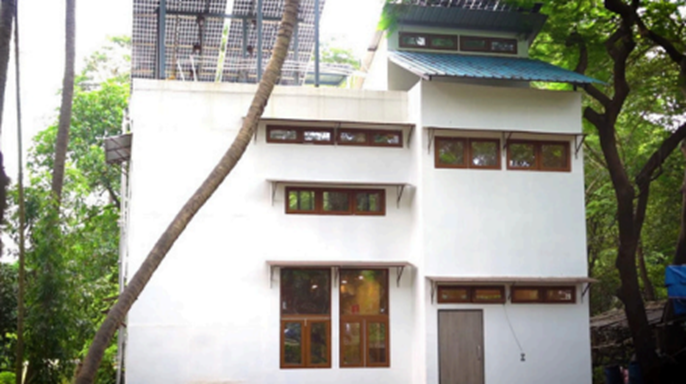
Project Vivaan was Team SHUNYA's entry to the US Solar Decathlon Build Challenge 2023. The project focuses on developing a sustainable residential ecosystem that goes beyond conventional net-zero energy housing by incorporating occupant well-being, resource efficiency, and system-level sustainability.
Designed for a typical urban family in high-density mid-income housing contexts, Vivaan adopts a holistic People-Planet-Profit framework - addressing thermal comfort, indoor environmental quality, and psychological well-being, while ensuring economic feasibility and long-term sustainability. Where earlier approaches relied primarily on rooftop solar for net-zero energy, this project extends the scope to tackle real-world urban challenges such as environmental stress and mental well-being.
The project achieves net energy positive and net carbon reduction targets alongside net-zero water management, supported by a multidisciplinary team of 50+ students from civil, electrical, energy, and mechanical engineering, guided by experienced faculty mentors.
Focus on mental well-being and occupant experience in dense urban environments — addressing psychological comfort alongside physical sustainability to create truly liveable homes.
Achieves net energy positive and net carbon reduction targets through renewable energy systems and smart building design, going beyond conventional net-zero benchmarks.
Integrated water sustainability strategies — including rainwater harvesting, greywater recycling, and water-efficient fixtures — balance total consumption with on-site collection and treatment.
Liquid desiccant systems enable efficient dehumidification, while an integrated app-based monitoring and control platform manages all building systems intelligently, paired with thermal energy storage for optimised efficiency.
Solar PV generation exceeds building demand, with thermal energy storage improving management efficiency. The home becomes an active energy contributor to the grid.
Renewable energy eliminates operational emissions while the People-Planet-Profit framework ensures the building's full lifecycle carbon footprint is minimised.
Rainwater harvesting and greywater recycling balance total consumption with on-site capture, closing the building's water loop and achieving net-zero water use.
Advanced liquid desiccant systems provide highly efficient dehumidification, maintaining indoor relative humidity within comfort ranges year-round while significantly reducing the energy load of mechanical cooling.
An integrated app-based monitoring and control platform gives occupants and facility managers real-time visibility and control over all building systems, enabling data-driven energy optimisation.
On-site thermal energy storage decouples energy generation from consumption, smoothing out demand peaks, improving overall system efficiency, and increasing the building's resilience.
Integrated rainwater harvesting tanks, greywater treatment and reuse circuits, and water-efficient fixtures close the building's water cycle, balancing total consumption with on-site collection for net-zero water use.
High-efficiency photovoltaic panels are sized to exceed the residence's total energy consumption, generating a surplus of clean energy that is exported to the grid for true net-positive performance.
Passive cooling strategies — cross-ventilation, thermal mass, shading, and strategic orientation — combine with human-centric design principles to maintain thermal comfort and support occupant mental well-being with minimal mechanical demand.
Discover SHUNYA's full portfolio of solar innovations spanning a decade.